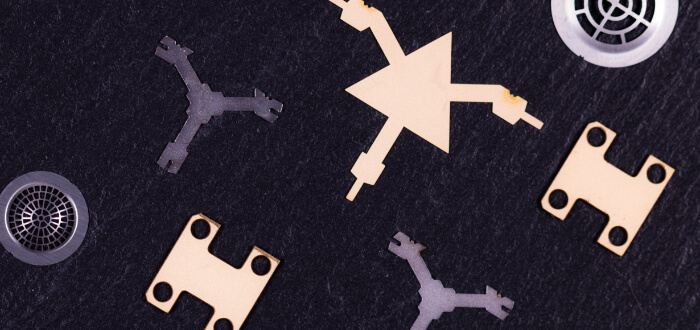
Metal Etching: Precision Chemical Etching Services for Complex Metal Components
Precision metal etching enables engineers to manufacture complex, high-accuracy metal components without the burrs, heat distortion, or mechanical stress associated with conventional fabrication methods. Also known as chemical metal etching, photochemical etching, photo chemical etching, or chemical machining, the process uses controlled chemistry rather than mechanical cutting to produce intricate parts with exceptional repeatability.
At Elcon Precision, we combine decades of manufacturing expertise, advanced process controls, and engineering support to produce precision-etched metal components for aerospace, defense, medical, semiconductor, electronics, and industrial applications. Whether you're developing a prototype or scaling to production, our photochemical etching process delivers the accuracy, flexibility, and consistency required for today's most demanding designs.
What Is Metal Etching?
Metal etching is a subtractive manufacturing process that selectively removes material from a metal sheet using chemical reactions instead of cutting tools. Unlike machining, stamping, or laser cutting, chemical metal etching creates intricate geometries without introducing heat, mechanical force, or residual stress into the material.
The process begins with a digital design that is transferred onto a photoresist-coated metal sheet. Areas not protected by the photoresist are dissolved during a precisely controlled chemical etching process, leaving behind the desired component.
Because material is removed uniformly rather than mechanically displaced, photochemical etching produces:
- Burr-free edges
- Fine features and intricate geometries
- Tight dimensional consistency
- Flat, distortion-free components
- Excellent repeatability from prototype through production
Engineers frequently choose precision metal etching when manufacturing thin metal components with complex patterns that would be difficult, expensive, or impossible to produce using conventional fabrication methods.
How the Chemical Metal Etching Process Works
Elcon Precision follows a tightly controlled manufacturing process that ensures consistent dimensional accuracy and repeatable production quality.
Digital Artwork & Phototool Creation
Customer CAD files are converted into high-resolution phototools that define the exact geometry of the finished component. Engineering reviews are performed to optimize the design for manufacturability while maintaining critical dimensions.
Photoresist Application
Sheets of metal are cleaned and coated with a light-sensitive photoresist on both sides, creating the foundation for accurate feature definition.
UV Imaging & Pattern Transfer
The phototool is aligned with the coated material and exposed to UV light. The exposed photoresist hardens while unexposed areas are removed during the development process, revealing the metal that will be chemically etched.
Controlled Chemical Etching
The metal passes through precision-controlled spray etching equipment where proprietary chemical etchants dissolve only the exposed material; for copper and brass, this can include ferric chloride, and the process works on sheet metal from 0.010 mm to 2.5 mm thick.
Because material is removed chemically rather than mechanically, it is suitable for hard, soft, or brittle metals and can be used on almost any metal:
- No cutting forces are applied
- No heat-affected zones are created
- Material properties remain unchanged
- Intricate features are etched uniformly across the sheet
Electrochemical etching is a separate method that uses electricity and an electrolyte solution, unlike this spray chemical process.
Resist Removal & Finishing
After etching, the remaining photoresist is removed, and the components are cleaned to help protect the finished part before further post-processing or inspection. Secondary operations such as forming, plating, or assembly can be incorporated as value-added services when required, and the same process can also support selective plating.
Inspection & Quality Verification
Each production run undergoes dimensional inspection and quality verification to ensure compliance with customer specifications and internal quality standards.
Why Process Control Matters
Successful photochemical etching depends on far more than simply exposing metal to chemicals. Factors including chemistry concentration, spray pressure, temperature, exposure time, and material characteristics must all be carefully controlled.
Elcon Precision maintains strict process controls to deliver:
- High dimensional repeatability
- Consistent feature definition
- Uniform edge quality
- Reliable production performance
- Predictable results from prototype through full-scale manufacturing
Benefits of Chemical Metal Etching
Burr-Free Components
Mechanical cutting often creates burrs that require costly secondary deburring operations.
Chemical etching eliminates burr formation, producing clean edges directly from the process while reducing post-processing requirements and improving overall part quality.
Stress-Free Manufacturing
Unlike laser cutting, stamping, or machining, chemical etching does not introduce thermal stress or mechanical forces, unlike processes that can introduce thermal stress through localized heat.
Benefits include:
- No heat-affected zones
- No work hardening
- No mechanical distortion
- Preserved material properties
- Improved flatness
This makes chemical machining particularly valuable for precision electronic, aerospace, and medical components where material integrity is critical and precise components are essential.
Greater Design Freedom
Photochemical etching supports complex designs that challenge traditional methods.
Engineers can incorporate:
- Fine slots
- Small holes
- Intricate patterns
- Thin webs
- Complex internal geometries
- High-density feature layouts
Design modifications can also be implemented quickly as component design changes without investing in expensive hard tooling.
Lower Development Costs
Compared to stamping or machining, chemical metal etching is a cost-effective option that offers significant cost advantages during product development.
Advantages include:
- Low-cost tooling with strong cost efficiency
- Rapid design revisions
- Fast prototyping
- Reduced development risk
- Economical low- and medium-volume production
- Smooth transition into larger production quantities, helping shorten lead times without compromising quality
Materials That Can Be Chemically Etched
Elcon Precision chemically etches a wide range of engineering metals selected to meet demanding mechanical, electrical, and environmental requirements.
Common materials include:
- Stainless steel
- Copper
- Brass
- Aluminum
- Nickel and nickel alloys
- Titanium
- Molybdenum
- Specialty and high-performance alloys
Material selection depends on application-specific requirements such as:
- Electrical conductivity
- Corrosion resistance
- Mechanical strength
- Thermal performance
- Weight reduction
- Environmental exposure
- Formability
Our engineering team works closely with customers to recommend materials that optimize both manufacturability and end-use performance.
Applications for Precision Metal Etching
The flexibility of photochemical etching makes it suitable for a broad range of precision components across multiple industries.
Electronics
- EMI/RFI shielding
- Electrical contacts
- Connectors
- RF components
- Lead frames
- Precision conductive components
Medical Devices
- Surgical components
- Implantable device components
- Precision filters
- Diagnostic equipment parts
- Thin metal assemblies
Aerospace & Defense
- Lightweight structural components
- Thermal management components
- Sensor elements
- Precision brackets
- Mission-critical hardware
Semiconductor Equipment
- Process equipment components
- Precision shims
- Thin metal features
- High-accuracy etched assemblies
- Precision alignment components
Industrial Applications
- Springs
- Filters
- Screens
- High-performance industrial components
- Flow control components
- Custom engineered metal parts, including etched parts used in industrial equipment
Why Choose Chemical Etching Over Other Manufacturing Methods?
Selecting the right manufacturing process depends on part geometry, material thickness, production volume, and performance requirements.
|
Process |
Chemical Metal Etching Advantage |
|
Stamping |
Lower tooling costs, faster engineering changes, ideal for prototypes and complex geometries |
|
Laser Cutting |
Burr-free edges, no heat distortion, superior edge quality on thin materials |
|
CNC Machining |
More economical for thin metals, greater feature density, reduced material waste |
|
Wire EDM |
Faster production for high-volume thin components with intricate patterns |
For thin precision components requiring tight tolerances and complex features, photochemical etching frequently provides the best balance of quality, cost, and design flexibility.
Why Engineers Partner with Elcon Precision
Manufacturing precision etched components requires more than advanced equipment—it requires engineering expertise and disciplined process control.
Decades of Manufacturing Experience
Elcon Precision has extensive experience producing chemically etched metal components for highly regulated industries where consistency and reliability are essential.
Advanced Process Capabilities
Our manufacturing processes utilize proprietary chemistries, precision-controlled equipment, and proven quality systems throughout the photochemical machining process to maintain exceptional repeatability throughout production. Capacity can also scale to significant production volumes, with over 100 tonnes of sheet metal processed annually in etching applications.
Engineering Support
Our engineers collaborate with customers from concept through production by providing:
- Design for manufacturability guidance
- Material selection recommendations
- Prototype optimization
- Production planning
- Continuous engineering support
Quality You Can Trust
Elcon Precision maintains rigorous quality standards supported by:
- AS9100D certification
- ISO 9001 certification
- ITAR registration
- RoHS-compliant manufacturing
Frequently Asked Questions
What is chemical metal etching?
Chemical metal etching is a manufacturing process that removes metal using controlled chemical reactions rather than cutting tools. It produces precise, burr-free components without heat or mechanical distortion.
How does photochemical etching work?
A photoresist is applied to the metal, exposed using a phototool, developed to reveal selected areas, and then chemically etched to create the desired component geometry.
What metals can be chemically etched?
Many engineering metals can be etched, including stainless steel, aluminum, copper, brass, titanium, nickel alloys, molybdenum, and numerous specialty metals.
Is chemical etching better than laser cutting?
For thin precision components, chemical etching often provides cleaner edges, eliminates heat-affected zones, and enables more intricate geometries than laser cutting.
What tolerances can chemical etching achieve?
Achievable tolerances depend on material type, thickness, and feature geometry. Elcon's engineering team evaluates each design to determine the optimal manufacturing approach and expected dimensional capability.
Is metal etching suitable for prototypes?
Yes. Because photochemical etching uses inexpensive phototools rather than hard tooling, it is well suited for rapid prototyping, design iterations, and short production runs.
What industries commonly use chemical etching?
Industries including aerospace, defense, medical devices, semiconductor manufacturing, electronics, telecommunications, and industrial equipment rely on chemical etching for high-precision metal components.
Ready to Start Your Metal Etching Project?
Chemical metal etching combines precision, flexibility, and repeatability to produce intricate metal components that traditional manufacturing methods often cannot achieve. By eliminating burrs, heat distortion, and mechanical stress, photochemical etching delivers high-quality parts that meet the demanding performance requirements of today's engineered products.
Whether you're developing a new prototype, refining an existing design, or scaling production, Elcon Precision provides the engineering expertise, advanced manufacturing capabilities, and quality systems needed to bring your project from concept to completion.
