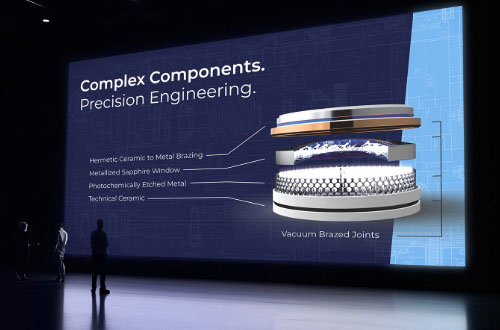
Photonic Integrated Circuits (PICs) are rapidly reshaping how data is transmitted, sensed, and processed across industries, from high-speed datacom and lidar to quantum systems, aerospace, and defense. As these photonic systems scale in complexity and power density, the challenges engineers face are no longer limited to optical design alone. Photonic integrated circuits typically include a combination of passive and active components. Thermal management, mechanical stability, electrical isolation, and long-term environmental reliability have become critical bottlenecks.
A photonic integrated circuit (PIC) is a microchip containing two or more photonic components that form a functioning circuit. This is how we view our partnerships at Elcon Precision, here to support your design from conception to production.
At the center of solving these challenges are advanced ceramic materials, which require extreme attention to detail and skilled experts at Elcon Precision, ready to fulfill the application requirements. From sapphire and silicon nitride to aluminum oxide and aluminum nitride, ceramics form the foundation of high-performance PIC packaging and integration. The most commercially utilized material platform for photonic integrated circuits is indium phosphide (InP), which enables the integration of active optical components like lasers and detectors, and is crucial for high-performance optical communication systems. The choice of substrate material in photonic integrated circuits affects properties such as transparency window and fabrication cost. We will explore the where and why ceramics matter in next-generation PICs, and how thoughtful material selection, and Elcon's knowledge of processing, can determine system performance and reliability.
Why Ceramics Are Foundational to Next-Generation Photonic Integrated Circuits (PICs)
Modern PICs integrate lasers, modulators, detectors, waveguides, and electronic drivers into increasingly compact modules. Waveguides are used in photonic integrated circuits to control and direct light through total internal reflection. In advanced PICs, electronic components are sometimes integrated alongside photonic components to enable more complex data processing and communication functions. As optical density and functionality increase, engineers must manage:
- Higher thermal loads from integrated active components
- Tight optical alignment tolerances
- Electrical isolation between RF, digital, and optical elements
- Protection from moisture, contamination, radiation, and pressure extremes
Ceramic materials enable these requirements to be met simultaneously. Unlike polymers or many metals, ceramics offer a unique combination of thermal stability, dielectric strength, mechanical rigidity, and environmental durability, making them essential to advanced PIC packaging, waveguiding platforms, and hermetic protection. Elcon is well versed in the fabrication techniques for photonic integrated circuits, similar to those used in electronic integrated circuits, utilizing photolithography for patterning and wafer processing.
We will continue to explore the ceramic materials most commonly used in PIC systems, where they are applied, and the engineering considerations that drive successful implementation.
Key Ceramic Materials Enabling PIC Performance
Sapphire (Single-Crystal Al₂O₃)
Sapphire is widely used in demanding photonic environments due to its unique combination of optical and mechanical properties:
- High optical clarity across a wide wavelength range
- Exceptional mechanical strength and stiffness
- Excellent resistance to radiation, important for space and defense applications
- Stability under aggressive temperature cycling
Sapphire is often selected for optical windows, waveguide platforms, and structural components where optical performance and long-term stability are critical.
Silicon Nitride (SiN)
Silicon nitride has become a cornerstone material for integrated photonics:
- Extremely low optical loss, ideal for waveguides and resonators
- Silicon nitride is valued for its broad transparency window and low propagation losses in photonic integrated circuits.
- Compatibility with CMOS fabrication processes
- High refractive index contrast, enabling compact circuit layouts
SiN is commonly used for waveguides, filters, routing layers, and resonant structures, especially in telecom, sensing, and quantum photonics applications.
Aluminum Oxide (Al₂O₃) Ceramics
Polycrystalline aluminum oxide remains one of the most widely used technical ceramics in PIC systems:
- Excellent electrical insulation properties
- Good thermal stability and mechanical strength
- Proven performance in high-reliability electronic and optical packaging
Al₂O₃ is frequently used for substrates, lids, carriers, and housings in PIC modules where insulation and dimensional stability are required.
Aluminum Nitride (AlN)
When thermal performance becomes the dominant constraint, aluminum nitride is often the material of choice:
- Very high thermal conductivity for efficient heat removal
- Strong electrical insulation
- Compatible with metallization and brazed assembly processes
AlN is commonly used for heat spreaders, baseplates, carriers, and high-power PIC packages, particularly in systems with integrated lasers or amplifiers.
Beyond raw materials, performance depends on process execution, and at Elcon, we pride ourselves on our commitment to craftsmanship. Machining, metallization, brazing, and assembly methods determine whether these ceramics can be effectively integrated into real-world PIC systems.
Where Ceramics Are Used Inside PIC Systems
Waveguides and Photonic Platforms
(SiN and Sapphire)
Ceramic-based waveguides provide:
- Low-loss optical routing
- Mechanical and thermal stability
- Compatibility with hybrid integration of lasers and detectors
A related concept is the planar lightwave circuit, which is a microchip that integrates various optical components on a single substrate. Planar lightwave circuits are essential for light manipulation and data transmission, and are highly relevant to modern photonic platforms.
These platforms are increasingly important in quantum photonics and advanced sensing, where signal integrity and stability are non-negotiable.
Substrates and Carriers
(Al₂O₃ and AlN)
Ceramic substrates form the mechanical backbone of PIC modules by:
- Supporting precise optical alignment
- Managing heat from lasers, amplifiers, and electronics
- Electrically isolating high-speed circuits
Material selection here directly impacts thermal gradients, signal integrity, and long-term reliability, and enables the integration of multiple functions on the same chip through advanced ceramic substrates.
PIC Packages and Housings
(Al₂O₃ and AlN)
Ceramic packages offer advantages over polymer or metal-only solutions:
- High dielectric strength
- Dimensional stability over temperature
- Compatibility with metallization, brazing, and hermetic sealing
These properties are essential for maintaining optical alignment and protecting sensitive photonic components.
Hermetic Seals and Electrical Feedthroughs
Many PICs require sealed environments, especially those containing lasers or detectors. Ceramic-to-metal brazed assemblies enable:
- Hermetic sealing with low outgassing
- Reliable electrical feedthroughs for high-frequency signals
- Long-term environmental protection
Engineering Challenges in PIC Packaging, and How Ceramics Solve Them
Heat Dissipation
As more active components are integrated, thermal loads increase. Aluminum nitride is often essential for rapidly pulling heat away from lasers and modulators, reducing thermal drift and extending device life.
Optical and Mechanical Stability
Ceramics offer low coefficients of thermal expansion relative to silicon, minimizing alignment drift. Sapphire and SiN resist warping and optical degradation under temperature cycling.
Electrical Isolation
PICs frequently combine RF, digital, and optical functions in close proximity. Al₂O₃ and AlN substrates maintain dielectric isolation while supporting high-speed signal integrity.
Environmental Protection
Hermetic ceramic packages protect PICs from:
- Moisture and contamination
- Vacuum and pressure swings (aerospace and space systems)
- Radiation exposure (defense, space, and nuclear sensing)
These challenges highlight why packaging decisions are often as complex and as critical as photonic design itself.
Why Ceramics Are Critical for Next-Generation Applications
Advanced ceramics are enabling the next wave of PIC-driven technologies, including:
- High-speed optical interconnects for datacom and telecom
- Lidar systems for automotive and defense
- Quantum photonics and integrated quantum platforms. Advances in photonic integrated circuits have moved their application beyond communication to include quantum computing and artificial intelligence.
- Space-based optical communication
- Harsh-environment sensing in radiation, vacuum, or cryogenic conditions
Quantum computing uses the quantum behavior of photons, and photonic integrated circuits are a key enabling technology for this rapidly developing field.
Ceramics future-proof these systems by supporting higher power densities, tighter integration, and hybrid electronic–photonic architectures without compromising reliability. Photonic integration enables the combination of multiple photonic components onto a single chip, resulting in compact and efficient photonic circuits. This technology is also used in AI accelerators, which perform complex vector-matrix multiplications at light speed.
What Engineers Should Consider When Selecting Ceramic Components for PICs
Selecting the right ceramic solution requires balancing multiple factors:
- Thermal demands: AlN for high heat loads; Al₂O₃ for moderate thermal needs
- Optical path requirements: SiN waveguides vs. sapphire optical components
- Packaging needs: Hermetic vs. non-hermetic environments
- Electrical insulation: Dielectric strength and signal integrity
- Process compatibility: Metallization, brazing, sealing requirements, and fabrication steps such as etching and material deposition for photonic integrated circuits
- Manufacturability: Size, tolerance, and geometry complexity
Engaging the ceramic and assembly experts at Elcon Precision early in the design phase often reduces risk, cost, and redesign cycles. We have decades of experience in the technologies and processes that have been at the forefront of those innovative fabrications these designs require when pushing the edge of what is possible.
Elcon Precision’s Capabilities for Ceramic PIC Components and Assemblies
Elcon Precision supports advanced PIC development through:
- Precision fabrication of sapphire, SiN, Al₂O₃, and AlN components, including support for the fabrication of photonic chips for advanced applications such as high-precision sensing, medical diagnostics, and optical communication systems
- Ceramic metallization tailored for photonic and electronic integration
- Ceramic-to-metal brazed hermetic seals and packages
- Integration of ceramics into optical housings, carriers, and PIC assemblies
- Tight tolerances to support optical alignment requirements
- High-reliability manufacturing for aerospace, defense, photonics, and semiconductor-adjacent markets
Elcon operates as an engineering partner, helping teams solve thermal, mechanical, and hermeticity challenges rather than supplying standalone parts. We go beyond the technical drawing and consider the application, the people behind the innovation, and the passion for the project.
Elcon Is Here to Support Your Next Innovation
Next-generation Photonic Integrated Circuits depend on advanced ceramic materials to scale performance and reliability. Sapphire, silicon nitride, aluminum oxide, and aluminum nitride each play distinct roles in managing heat, preserving optical stability, ensuring electrical isolation, and protecting sensitive components from harsh environments.
As PIC architectures become more complex, ceramics are no longer optional, they are foundational. Elcon Precision provides the ceramic components, brazed assemblies, and engineering collaboration required to build high-performance, reliable PIC systems for today’s most demanding applications.
Our relationship with our customers is more than a contract, it's a commitment to one another that we will see it through, the struggles and the successes, we are here from start to finish.
